

The Anatomy of Problem
the word “problem” often feels like a weighty, negative concept. something to be avoided or fixed as quickly as possible. but what if we reframed it? What if we respected problems...as entities...?

‘Problems are opportunities.’ I first heard this phrase while studying customer relationship management in 2017. In that context, it referred to how front-line personnel should approach the challenges brought by agitated customers, not as inconveniences, but as chances to win their loyalty by solving their problems and exceeding their expectations. This perspective, then, was a revelation to me.
I began to see problems differently: as raw materials passing through a refinery to become opportunities, with multiple derivatives, such as; happy customers, increased loyalty, referrals, word-of-mouth marketing, and so much more. It’s magical, isn’t it?
Indeed, understanding the act and art of problem-solving transforms you into something of a mage - a creator of opportunities, a solver of riddles. But what is problem-solving, really?
What is Problem-Solving?
According to the Oxford Dictionary, problem-solving is simply “the act of finding ways of dealing with problems.” Other sources offer similar definitions. Straightforward but often superficial.
To uncover its deeper essence, let’s start by breaking down the word “problem.”
The term comes from the Greek word problēma, later adapted into Latin and French as problema and problème, respectively. The Greek origin combines two root words: pro, meaning “before” or “in front of,” and ballein, meaning “to throw” or “put.” Essentially, a problem is something “thrown in front of” someone, initially used in contexts like philosophy to denote a theoretical question posed for consideration. Over time, it evolved into a term for intellectual challenges across various fields, from mathematics to engineering and beyond.
A problem, therefore, involves three characters:
What is thrown.
Who or what throws it.
To whom it is thrown.
But before we explore these characters, we must address an even more fundamental question: Why is it thrown? This leads us naturally to the concept of solving.
What is Solving?
The word “solve,” and its derivatives like “solving” and “solution,” trace back to the Latin solvere, meaning “to loosen, release, untie, or free.” This, too, has a dual-root origin: se, meaning “apart,” and luere, meaning “to loosen.” In essence, solving is the act of untying something bound.
By the 14th century, the English adopted this term to describe the resolution of challenges, difficulties, and puzzles. A usage that has persisted and expanded ever since.
When we bring these roots together, we see that problem-solving is, at its core, the act and art of “untying a bound” that is “thrown in front of us.”
Pro + Ballein
The word “problem” often feels like a weighty, negative concept. Something to be avoided or fixed as quickly as possible. But what if we reframed it? What if we respected problems, appreciating them as “entities” worthy of our curiosity and understanding? This shift in perspective is crucial to mastering the art and science of problem-solving.
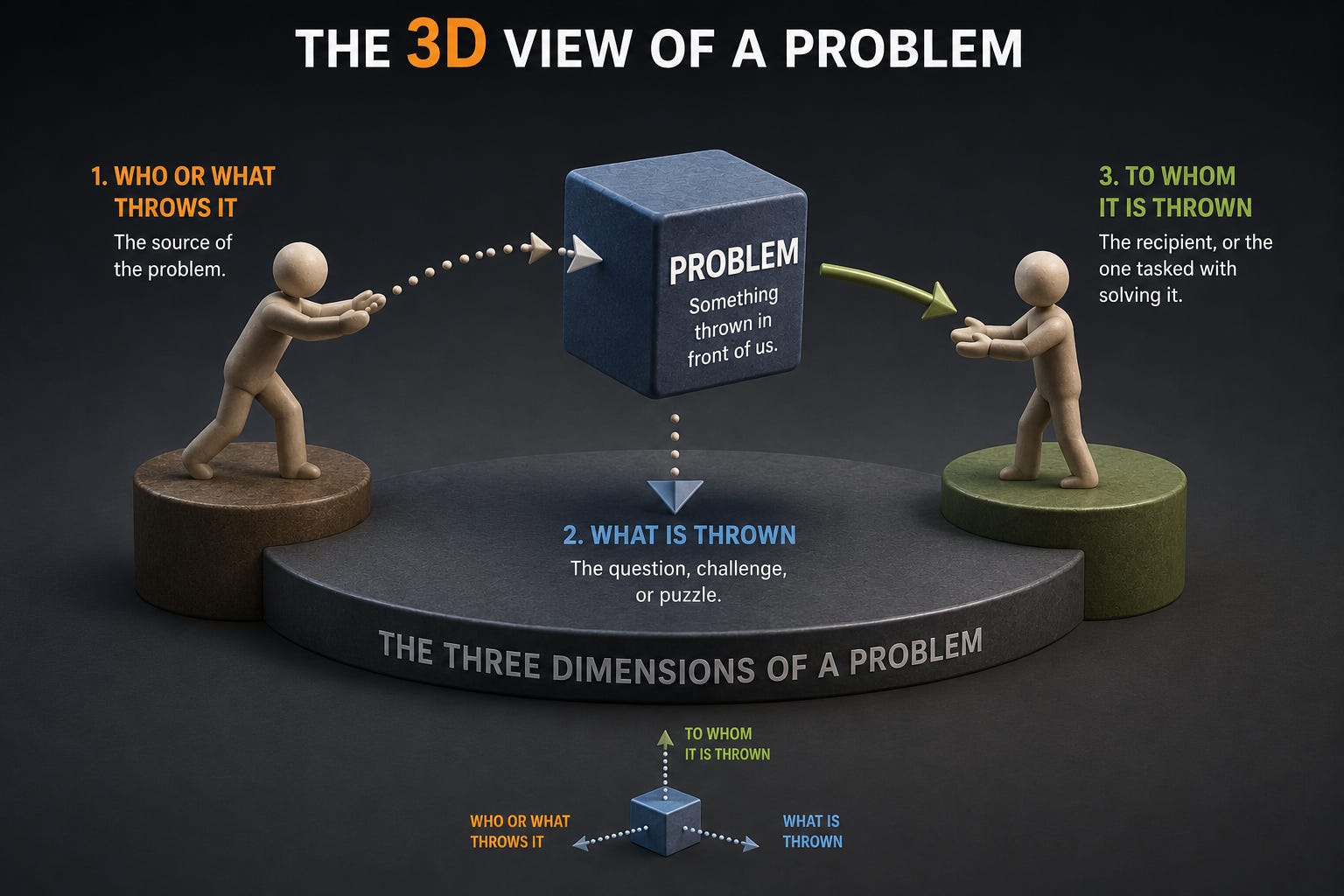
As we discovered earlier, the word problem originates from the Greek roots pro (before, in front of) and ballein (to throw, put). At its core, a problem is “something thrown in front of us.” From this, we can identify three key dimensions of a problem:
What is thrown: the question, challenge, or puzzle.
Who or what throws it: the source of the problem.
To whom it is thrown: the recipient, or the one tasked with solving it.
These three dimensions offer a 3D view of problems, a perspective that is often overlooked. Let’s break this down further.
The Three Dimensions of a Problem
1. What is thrown:
This is the challenge itself, the puzzle demanding resolution. For instance, consider a mathematical equation like 3x + (5 - 3) = 1. The equation is the problem, presented as a set of variables and constants waiting to be solved. In other scenarios, it could be a natural phenomenon, such as the mysteries of space and time that Einstein sought to unravel.
2. Who or what throws it:
Every problem has a source. For a student, it might be a teacher or a textbook. For Einstein, it could be argued that the universe itself posed the challenge, presenting questions about space and time. Interestingly, the “thrower” of a problem is not always external. Sometimes, we throw problems at ourselves, curiosities sparked by observation, reflection, or ambition.
For instance, Einstein might have “thrown” the problem at himself, driven by his observations of the universe and the intellectual challenges posed by peers and predecessors. Similarly, events, errors, or systemic failures can also act as throwers. Consider a poorly designed economic policy that leads to widespread poverty. Such problems often come with cause-and-effect dynamics that further deepen their complexity.
3. To whom it is thrown:
Finally, every problem needs a recipient. This could be an individual (you, a CEO, or a leader) or a group (a government, a team, or society at large). For example, when a country faces an economic crisis, the challenge is often thrown at its leaders (governors, presidents, ministers, policymakers etc). Therefore, we must recognize that recipients are not always singular.
The Mistake of One-Dimensional Thinking
Most people view problems through a narrow lens, focusing on just one or two dimensions. For example, they may identify what is thrown but overlook who or what throws it and to whom it is thrown. This one-dimensional perspective limits understanding and hinders effective solutions.
Even when people say, “I have a problem,” they’re often only addressing two dimensions: the I (to whom it is thrown) and the “problem” (what is thrown). Rarely do they pause to consider the source (who or what throws it) and even more rarely do they ask why the problem exists.
This lack of respect for the problem itself (its origins, its nature, its purpose) leads to superficial solutions. A deeper appreciation, however, unlocks profound insights.
The Power of Reverence for Problems
By appreciating problems as entities with their own characteristics and dynamics, we embark on a journey of understanding that is foundational to effective problem-solving. The act of asking why a problem exists opens doors to clarity and context. Who or what threw the challenge? Was it the universe, a system, an event, or even yourself?
For instance, when Einstein grappled with the mysteries of space and time, understanding why the problem existed likely shaped his path to solving it. Was it simply the universe posing an intellectual challenge, or was it a self-imposed curiosity born of observation? This exploration is both academic and practical.
Consider another example: a poor economic policy leading to widespread poverty. Here, the “thrower” might be the policymakers who designed the flawed policy, or perhaps the external circumstances that shaped their decisions. Understanding these links helps us see problems as cause-and-effect systems, enabling us to approach solutions with greater precision.
A 3D Lens of Appreciation
When next you face a problem, put on this 3D binoculars:
What is thrown?
Who or what throws it?
To whom is it thrown?
Do not rush to conclusions. Observe. Ask questions. Reflect. This practice is nearly half the battle in solving problems. By understanding problems more deeply, you unlock the key to solving them effectively.
In subsequent episodes of Solutions Letter, we will dive deeper into this crucial stage of problem-solving, exploring how observation and curiosity illuminate the nature of problems. For now, hold on to this 3D lens of appreciation. It will serve as your guide to mastering the art of problem understanding.